three.js
smlibpy-three (@classcad/smlibpy-three on npm) is smlibpy's modeling API for three.js. Parts,
sketches, faces, edges and curves are three.js objects: a part is a THREE.Mesh, an edge a
THREE.Line. They take and give three's types (Vector3, Matrix4, Plane, Ray, Box3,
Shape, Curve, BufferGeometry) in three's coordinates and follow three's conventions:
new Box(80, 10, 60) is the box THREE.BoxGeometry(80, 10, 60) would be, cylinders stand along y
as CylinderGeometry's do, sketches lie in the XY plane and extrude along +z as ShapeGeometry and
ExtrudeGeometry do, and angles are radians. Underneath is smlibwasm, the SMLib
kernel in WebAssembly; none of it shows.
import * as THREE from 'three'
import { Box, Cylinder, GridLocations, Hole, Locations, Rectangle, Y } from '@classcad/smlibpy-three'

const scene = new THREE.Scene()

let part = new Box(120, 12, 80, { align: { y: 'min' } }) // a THREE.Mesh, lying on the ground
part = part.fillet(part.edges().parallelTo(Y), 10)

const top = part.faces().top().one()
part = part.fuse(new Rectangle(50, 30, { fillet: 6 }).on(top).extrude(24)) // a sketch on the top face, extruded up

const [frame] = Locations(top) // the face's frame: its z is the face's normal
part = part.cut(new Hole(5, 20).at(GridLocations(90, 50, 2, 2).map((m) => frame.clone().multiply(m))))

const bore = new Cylinder(8, 8, 100) // along y, as THREE.CylinderGeometry(8, 8, 100)
bore.rotation.x = Math.PI / 2 // tools are placed with three's transforms
bore.position.y = 24
part = part.cut(bore)

scene.add(part)
console.log(part.volume.toFixed(1)) // 139626.5

// three's Raycaster, straight down onto the boss
const raycaster = new THREE.Raycaster(new THREE.Vector3(20, 100, 0), new THREE.Vector3(0, -1, 0))
const [hit] = raycaster.intersectObject(part)
console.log(hit.point.y, hit.brep.isBrepFace) // 36 true
// hit.brep is the face that was hit (a THREE.Mesh): the boss's top, 50 by 30 with corners of radius 6
console.log(hit.brep.area.toFixed(1)) // 1469.1
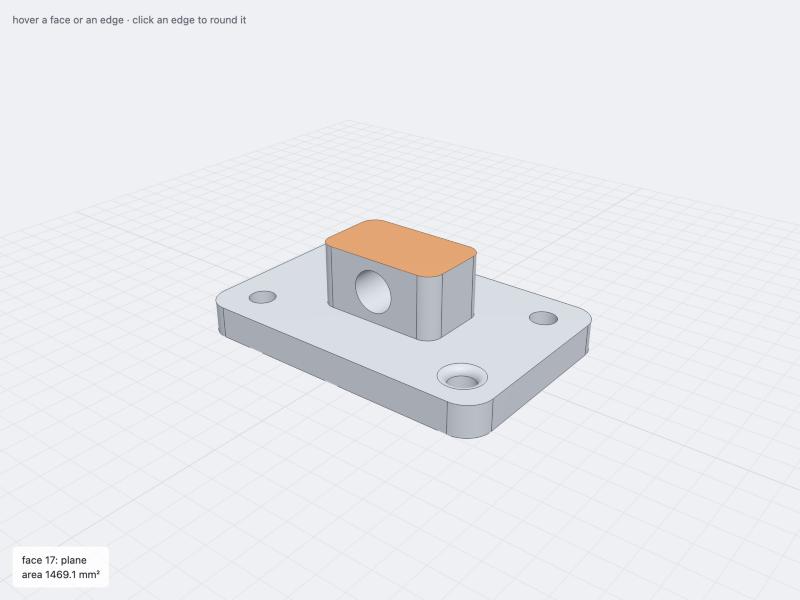
The package is released with smlibpy and smlibwasm, at their version, and wraps all of smlibwasm's
public API; what it leaves to three, and why, is listed below. The
repository's example page (smlibpy-three/example, npm run example there) shows a part, a
raycast hover, and a click on an edge that rounds it.
Install
npm install @classcad/smlibpy-three three
@classcad/smlibwasm comes with it: the release of the same version, or a later patch (^ that
version); three is a peer, 0.186 or later.
Importing the package loads the kernel (a top-level await), and after that every call is
synchronous. The package adds 0.10 MB to smlibwasm's 2.9 MB (its JavaScript as
published, with brotli; 0.12 MB with gzip, 0.42 MB uncompressed).
@classcad/smlibpy-three/init loads the kernel from elsewhere, as smlibwasm's
init does (init({ locateFile })), and
@classcad/smlibpy-three/worker runs modeling functions in a worker (below).
Vite's dev server must leave smlibwasm out of its prebundling:
// vite.config.js
export default { optimizeDeps: { exclude: ['@classcad/smlibwasm'] } }
Every shape is a three object
| smlibpy | here | extends |
|---|---|---|
Part, Box, Cylinder, Cone, Sphere, Hole, ... | Part and its subclasses (Box, Cylinder, Cone, Ball, Hole, ...) | THREE.Mesh |
Shell, Sketch, Rectangle, Circle, Text, ... | Shell, Sketch and its subclasses | THREE.Mesh (double sided) |
| the edges of a body, drawn | body.edgeLines (a child of the body) | THREE.LineSegments |
Face | BrepFace | THREE.Mesh |
Edge, Line, Spline, Helix, CenterArc, ... | BrepEdge and its subclasses (Segment, Spline, ...) | THREE.Line |
Wire, Polyline, FilletPolyline | Wire and its subclasses | THREE.Line |
Vertex | BrepVertex | THREE.Points |
Mesh (triangles) | TriangleMesh | THREE.Mesh |
ShapeList | ShapeList (an Array, with smlibpy's selectors) | Array |
A body's geometry is the tessellation of its exact B-rep: one geometry cut from one tessellation
of the whole body (faces share the points where they meet), vertices split per face, with the
kernel's normals of the exact surfaces (not averaged ones), and faces' own colors as vertex colors.
It is made when three first reads it (to render, raycast, measure with Box3): intermediate parts of
a modeling chain are never tessellated. part.tolerance (chord height) and part.angle set how
fine; clones share one tessellation, as three's clones share their geometry. The material is any
three material; the default is a MeshStandardMaterial pushed back with polygonOffset so the edge
lines show (an app material without it hides them). They behave as any Object3D: scene.add,
position, rotation, scale, layers, visible, clone(), copy(), toJSON() (plain Mesh
and LineSegments that ObjectLoader reads back), three's renderers, Box3.setFromObject, three's
GLTFExporter and STLExporter for the tessellation. Classes keep three's type ('Mesh', 'Line', ...)
and add flags (isPart, isBody, isBrepFace, isBrepEdge, ...). No export shares a name with
three's (core or addons): smlibpy's Line, Sphere, Triangle, Font, Face, Edge and Vertex
are Segment, Ball, TriangleSketch, OpenTypeFont, BrepFace, BrepEdge and BrepVertex here.
three's coordinates, three's geometries
The kernel works in three's coordinates: a point (x, y, z) is the kernel's (x, y, z), and there is no axis change anywhere. Where smlibpy assumes Z up, the package follows three instead:
-
Solids take three's geometries' arguments, defaults and placement (without their segment counts: the solids are exact; a number where the options go is a TypeError):
three here BoxGeometry(width, height, depth)new Box(width, height, depth)CylinderGeometry(radiusTop, radiusBottom, height, …, thetaStart, thetaLength)new Cylinder(radiusTop, radiusBottom, height, { thetaStart, thetaLength })ConeGeometry(radius, height, …, thetaStart, thetaLength)new Cone(radius, height, { thetaStart, thetaLength })SphereGeometry(radius, …, phiStart, phiLength, thetaStart, thetaLength)new Ball(radius, { phiStart, phiLength, thetaStart, thetaLength })TorusGeometry(radius, tube, …, arc)new Torus(radius, tube, { arc })RingGeometry(innerRadius, outerRadius, …, thetaStart, thetaLength)new AnnularSector(innerRadius, outerRadius, height, { thetaStart, thetaLength })Cylinders and cones stand along y, a ball's poles are on y, a torus and a ring lie in the XY plane, each centered as three centers it and turned as three turns it (a sector of a cylinder runs from +z towards +x, as
CylinderGeometry's).PyramidandWedgetake a box's(width, height, depth)and stand along y;Holedrills along -z into a face (below).alignmoves a solid by its bounding box ({ y: 'min' }stands it on the XZ plane). -
2D is the XY plane, as three's 2D shapes and curves are: sketches lie in it and face +z (
ShapeGeometry), extrude along +z (ExtrudeGeometry) and revolve about y (LatheGeometry); a sketch's own (x, y) is three's (x, y). Arcs, ellipses, spirals and the pen ofProfileturn counterclockwise seen from +z (EllipseCurve), text reads along +x seen from the front, a helix rises along +z (three'sHelixCurve). Patterns (GridLocations,PolarLocations), flat patterns of sheet metal, drawing views, DXF and SVG lie in the XY plane too. -
A face's frame has its z along the face's normal, as a sketch on it lies:
sketch.on(face)draws on the face,Locations(face)gives frames there, and aHoleplaced at one drills into the face. A cylinder (along y) stands on a face once turned (cylinder.rotation.x = Math.PI / 2). -
Directions are three's:
top()is the highest along +y,front()the nearest along +z (towards three's default camera),right()along +x. Deformations twist, taper and unroll about y and bend toward +y by default. Pictures' named views look as they say in a three scene ('top' from +y, 'front' from +z). -
Files are read and written as they are, as three's STLLoader and OBJLoader take files: a file's coordinates are three's. CAD files are mostly Z up: stand what a loader gives in a Y-up scene with
group.rotation.x = -Math.PI / 2, as three's loaders turn assets that say they are Z up. USD says so:USDBrepLoaderturns a Z-up stage that way, as three's own USDLoader does, andUSDBrepExporterwrites a Z-up stage of what the scene shows.
three's types in and out
| smlibpy | here |
|---|---|
Vector (points, directions) | THREE.Vector3 (or any { x, y, z }); results are new Vector3s, or fill a target |
| sketch coordinates | THREE.Vector2, and THREE.Shape, THREE.Path (with holes): new Sketch(shapes) |
Location, Pos, Rot | the object's transform; THREE.Matrix4 where a placement is an argument |
Locations, GridLocations, ... | THREE.Matrix4[]; shape.at(locations) gives clones placed there |
Plane | THREE.Plane (split, section, mirror, face.plane); a Matrix4 where a frame is meant (frame) |
Axis | THREE.Ray (revolve, fold, face.axis, deformation axes) |
BoundBox | THREE.Box3 |
X, Y, Z | three's axes as frozen Vector3s: Y is up |
| curves as arguments (paths, rails, outlines) | BrepEdge, Wire, or any THREE.Curve<Vector3> |
Mesh (triangles) | TriangleMesh; from any THREE.BufferGeometry (also by assigning one to its geometry), and new Part(geometry) makes a body of a closed one |
NurbsSurface data | plain data, or three's NURBSSurface (addons) |
| degrees | radians, as everywhere in three |
import_step, to_step, ... | loaders (THREE.Loader: load, loadAsync, parse) and exporters (parse) |
MassProperties, DraftAnalysis, Bend, ... | the package's records, in three's types |
ModelingError, KernelError, FontError | the package's own, with the same fields, in the package's words |
three's curves become exact kernel curves: lines, arcs and ellipses (with three's angles, direction
and rotation), quadratic and cubic Béziers as the same curves, and Catmull-Rom splines
(SplineCurve, CatmullRomCurve3 of all three types) as B-splines that run exactly where three's
run: each segment of three's is a cubic Hermite curve, so a Bézier curve. Other curves (an app's own
subclass) are fitted through points. So an SVG (SVGLoader.createShapes) or a font
(Font.generateShapes) becomes an exact sketch where three's ShapeGeometry would lie, and a solid.
The other way, edge.curve is a THREE.Curve along the exact edge:
new THREE.TubeGeometry(edge.curve, 64, 1).
Placement
- Coordinates are in the object's own frame, as a geometry's are: what a query gives (
getCenter(),bbox(),pointAt(),normalAt()) and what a method takes (a point, a direction, aTHREE.Plane, aTHREE.Curve) is in the frame of the object it is called on. - Shapes given to an operation are taken where they are in the world (their
matrixWorld), asobject.attach()keeps an object where it is: a tool moved withtool.position.x = 10, turned withtool.rotation.y, scaled, or placed in a group, cuts there (TransformControlson a tool, thenpart.cut(tool)). Scales go to the kernel too (a scale different per axis makes B-splines of the faces). - The result is in the frame of the object the operation is called on and has its transform, name,
flags and material, as its
clone()would: it takes the original's place in the scene graph, also in a group. (A sheet or sketch made from a part keeps its own, two-sided material.) A free function's first shape plays that object. - A body's faces, edges and vertices are where the body is.
One API: methods and functions
The package follows smlibpy's rules for the API, as smlibwasm does:
- Every operation of a body is a method and a function.
part.draft(faces, angle, plane)isdraft(part, faces, angle, plane): the function has the method's name and parameters, takes the body first, gives what the method gives (in the body's frame, with its transform), and is a TypeError, saying what it takes, for a shape it does not take.fillet,chamferandfilletPreviewtake the edges and find their part. Two names are three's:scaleis a function only (an object'sscaleis its transform) andoutlinea method only (three's TSL has anoutline). - What stays a method: selections and topology (
faces(),top()), measuring and checking (bbox,classify,check), placing (three's transforms,at,on), representations (toMesh,toNurbs). What stays a function: what makes a shape of several (loft,blend,network,fitCurve), files (loaders and exporters), pictures (render). - Parameters are named in full (
tolerance,angleTolerance), choices are typed (corners: 'round' | 'sharp'), and every export has a doc comment (the three.js API shows them). - smlibwasm's old forms are not the package's. smlibwasm keeps an option it renamed
(
angleTol) and a flag it took by position (edges(true)) working for a release, with a warning; the package never had them, so it refuses them as an option it does not have ("did you mean 'angleTolerance'?").
Values and objects
Operations return new objects and leave their inputs as they were, as smlibpy's do
(part.fillet(...) is a new part). What is three's (transform, material, visibility, children) is
changed in place as on any object. A parametric rebuild makes a new part and puts it where the old
one was (the example page does it on a click), or copies it into the old object as three copies
objects: part.copy(scope(() => model(params))). Each face, edge and vertex is one object per body,
made when first asked for: part.faces()[3] is the same object every time, and the one a raycast
hit gives.
Picking: three's Raycaster
There is no picking API of the package's own. A body's raycast is three's Mesh.raycast, and on
each intersection it sets intersection.brep to the face that was hit; the body's edgeLines are
three's LineSegments (hit within raycaster.params.Line.threshold, in world units, as three hits
lines) and set the edge. Everything else on the intersection is three's, and three's rules hold
(layers, recursion, invisible objects are hit). brep is one key, which survives R3F's spreading of
intersections into its events (e.brep) and collides with no DOM event property. The face of a hit
is found from the hit triangle's vertex (vertices are split per face), so it stays right whatever
order a BVH puts the triangles in. The kernel's exact ray cast is body.intersectRay(ray).
A face, edge or vertex of a body draws itself: add it as a child of its body and it shows in place,
in its own highlight material (part.add(hit.brep); remove it again to clear the highlight), after
the body's edge lines (renderOrder 1), in WebGLRenderer and WebGPURenderer alike. These children
are not raycast, so they do not hit twice. Lines are drawn as three draws them, one pixel wide; fat
lines or tubes for highlights are the app's choice (the example page draws a tube along
edge.curve). Points too: WebGPU draws them one pixel wide, so on WebGPURenderer's WebGPU backend a
vertex's highlight is a pixel (WebGLRenderer draws it 8 pixels wide).
Disposal and memory
dispose() frees what the object made: its tessellation (once no clone draws it), its own default
materials, and its kernel body (once no clone holds it), and fires three's 'dispose'. A material
assigned to it is the app's, as with any three object. A disposed body stays in the scene as it was
drawn (three uploads a disposed geometry again); modeling with it throws. Without dispose() the
garbage collector frees the kernel's bodies (smlibwasm's FinalizationRegistry), between tasks of the
event loop. In a loop that does not return to the event loop, scope(fn) disposes what fn made
and its result does not hold.
Off the main thread
Kernel calls are synchronous. @classcad/smlibpy-three/worker runs modeling functions in a worker
(expose there, new KernelWorker(...) here), on smlibwasm's transport (see
Running off the main thread): bodies cross as their
exact kernel bodies with their transform, name and settings, faces and edges as their body and index
(a seam as its place among the edges with the seams), curves, meshes, groups and three's math types
as themselves; materials stay on their thread (their color and name cross). A body coming back
brings its tessellation, made in the worker, so the page only uploads it to the GPU: tessellating is
the slow step of drawing a large part. A call can time out or be aborted; a crash or a timeout ends
the worker, and the next call starts a new one.
What it leaves to three
All of smlibwasm's public API is wrapped, but for these, and the repository's
smlibpy-three/test/forms.test.ts checks it name by name:
- smlibwasm's value classes (
Vector,Axis,Location,Plane,BoundBox,Pos,Rot,Hit,Nurbs, ...): three's types stand in for them, and the package's records for its results. translate,rotate,movedandLocations.mul: placement is three's transforms (position,rotation,scale,applyMatrix4) andshape.at(locations); scaling a body itself is the functionscale(shape, factor). A face, edge or vertex of a body is where its body is: it is not placed or mirrored on its own (face.toShell()is a sheet of it), and has no faces, edges or vertices of its own kind (it is one).- Members under names three's objects have, or that three's renderers read off every object they
draw: smlibpy's
raycastisintersectRay(three'sraycastkeeps its protocol),center()isgetCenter()(three's name, asBox3.getCenter: three's WebGPURenderer reads an object'scenteras a Sprite's, and failed on every body with a method of that name),Edge.add/Wire.addisnew Wire([a, b]), a mesh'slengthistriangleCount,meshistoMesh(a curve's mesh: its polyline geometry), a whole body'snamed/coloredis its object'snameand material (faces:nameFaces,colorFaces), and the functionoutlineis three's (a TSL node): call the method. - The viewer (
show,htmlPage): three is the viewer. - Mesh formats (STL, OBJ, glTF/GLB): three's own loaders and exporters do them; a body is a Mesh,
and a
TriangleMeshis made of any BufferGeometry. - Node path functions (
exportStep,importStep,readStep,save,load,Shape.export,Picture.save): loaders take URLs and bytes, exporters give text or bytes. - The raw kernel layer (
@classcad/smlibwasm/kernel): no stable API, and it would show smlibwasm. - IGES export and binary USD: smlibwasm has none either. render's
annotate: it labels the kernel's stage, not three's axes. A mesh's kernel arrays: its geometry is their three view.
API
The API reference has a page of its own: three.js API, every export of
@classcad/smlibpy-three as a TypeScript declaration with its doc comment, beside the
Python API and the WASM API.